In this guide
How do the Challenger 3500 and Praetor 600 compare?
Compare the Challenger 3500 with the specific Praetor version quoted. This article uses the original Praetor 600 brochure. Embraer announced the first Praetor 600E delivery in September 2026; newer cabin features should not be assumed on a 600. Embraer ↗
| Decision | Challenger 3500 | Praetor 600 |
|---|---|---|
| Published reference range | 3,400 nautical miles | 4,018 nautical miles |
| Range interpretation | Manufacturer theoretical mission conditions apply | Four passengers at long-range cruise; stated reserves apply |
| Cabin distinction to inspect | Nuage seating and the offered seat arrangement | Six-foot flat-floor cabin and berthable seating |
| What the quote must establish | Passenger layout, load and actual flight plan | Passenger layout, load and actual flight plan |
Range and cabin descriptions are manufacturer references, not predictions for a fully occupied charter. Bombardier ↗ Bombardier ↗ Embraer ↗
When does the Praetor 600’s extra published range matter?
Additional reference range matters when the operator’s assessment shows it changes your real itinerary, especially whether a fuel stop is needed. It is less useful as a reason to pay more when both proposals comfortably satisfy the same flight brief.
Consider an illustrative London–New York request with four adults, luggage and a fixed arrival meeting. Ask each operator for a flight plan for the intended date, direction and airports. Require the proposal to identify any expected fuel stop and explain the alternatives if conditions change. This example is not confirmation that either aircraft will operate the requested flight nonstop.
The New York–London charter guide helps frame the route. A range circle cannot account for the particular day’s winds, reserves, routing or payload, and subtracting map distance from brochure range does not produce a dependable fuel margin.
Which aircraft is better for working or resting?
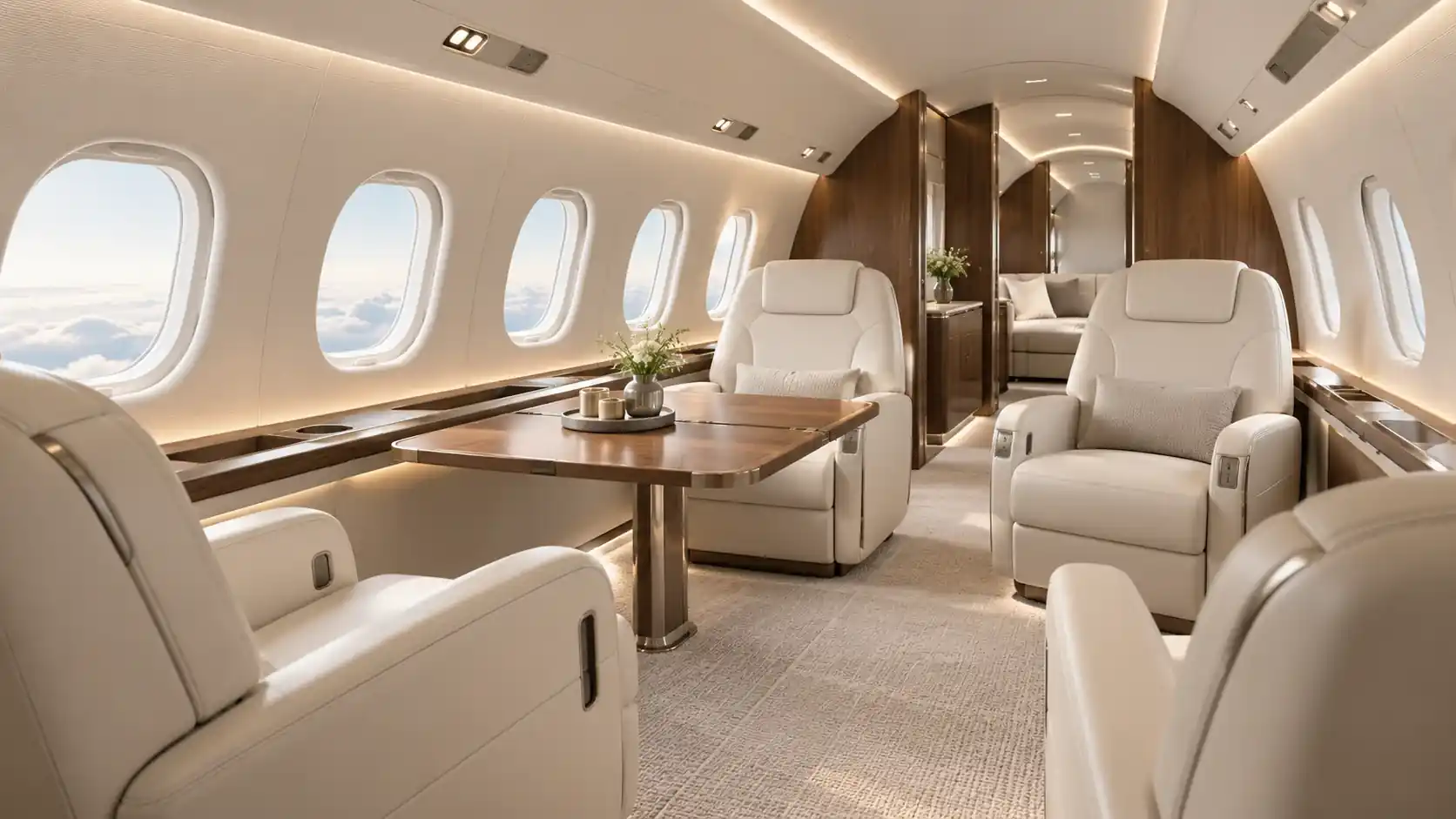
The right choice depends on how your group uses the cabin during the journey. Request the actual seating plan in both seated and sleeping arrangements, then check whether people can rest without blocking the spaces others need.
For an illustrative six-person daytime business trip, usable table positions and connectivity may matter more than a bed arrangement. For an overnight journey with a family, ask how many separate sleeping places the operator can prepare, how they are made up, and which seats remain available. A marketed seat count is not a bed count.
Request the offered aircraft’s connectivity provider, coverage, included use and equipment status. Ask who provides cabin service and what meal arrangements the quote includes. Our Challenger 350 family guide covers the predecessor context; do not treat a 350 proposal as automatic fulfillment of a 3500 request.
How should luggage and airport requirements be compared?
Send the same complete load and airport brief to both providers before choosing a model. Passenger count alone does not describe golf bags, ski cases, mobility equipment or a large dog’s approved cabin arrangement.
Ask the operator to confirm baggage access and physical fit, including door openings and any items needed in flight. If pet space is important, use our large-dog flight planning guide and obtain written approval for the particular aircraft.
A resort airport introduces additional questions about runway conditions, elevation, handling and acceptable arrival times. Have the operator assess the actual airport and a practical alternative. A manufacturer’s short-runway illustration does not establish permission or suitability for every loaded charter into a similarly sized runway.
How do you choose between the actual quotes?
Choose by the complete trip product: confirmed operational fit, cabin arrangement, price and change terms. We have not established that either model is consistently cheaper, more comfortable for every traveler or superior in safety.
- Match the exact airport pair, passenger load, departure window and return plan.
- Ask whether the total includes positioning, handling, applicable taxes, crew expenses and the requested service.
- Identify possible extras for deicing, parking, itinerary changes and special requests.
- Ask how a fuel stop, technical issue or aircraft substitution affects timing and payment.
If both meet the brief, compare the practical benefit you receive for any price difference. If only one meets a must-have requirement, the other is not an equivalent lower-cost option. Read how charter pricing works and submit a consistent brief through our charter request page.
Frequently asked questions
Does the Praetor 600 have more range than the Challenger 3500?
Its manufacturer-published reference range is greater, but each figure has mission assumptions. The operator must determine actual nonstop capability using your load, airports and expected conditions.
Is a Praetor 600 the same as a Praetor 600E?
No. The 600E is a later version with cabin changes. This comparison uses the original Praetor 600 reference brochure; confirm the version and fitted equipment in a quote. Embraer ↗
Does a Challenger 3500 guarantee a more comfortable ride?
No universal comfort ranking is established here. Seat configuration, personal preferences, trip length and conditions matter. Inspect the offered cabin and distinguish manufacturer claims from a guarantee.
Should I choose solely by nonstop range?
No. First establish whether each aircraft can meet the itinerary. Then compare cabin fit, baggage, service, airport access, total price and the terms if plans change.
Sources & research
Sources checked October 11, 2026. Reference comparison is Challenger 3500 versus Praetor 600; Praetor 600E features are identified separately. Recommendations are editorial analysis, not firsthand aircraft testing or an operational release.
- Bombardier — Challenger 3500 environmental product declaration ↗
- Bombardier — Challenger 3500 aircraft ↗
- Embraer — Praetor 600 brochure ↗
- Embraer — Inaugural Praetor 600E Delivered to Fleet Launch Customer Flexjet ↗